10 Best Animals to See in the Serengeti: A Luxury African Safari in Tanzania
Witnessing Serengeti Wildlife Encounters on the African Savanna
Remember the childhood diary scene from the biopic, “Michael” (2026), where the young Michael Jackson writes that in the Serengeti, animals are “only afraid of the rain, not of each other,” and that he wants to go there because “no one gets hurt.” (1) In his list of animals to see in the Serengeti, he refers to lions and elephants as the “true kings” who “don’t have to follow anyone’s rules,” and addresses giraffes as “gentle” and “quiet” observers who see everything without needing to speak.
For discerning travelers asking what animals you can see in the Serengeti, the answer is both grand and nuanced. The Big Five matter, the great cats thrill, and the Great Migration at the Mara River crossings are unforgettable. The true seduction of the Serengeti lies in the variety of wildlife encounters: a lion pride draped across a kopje at dawn, a leopard’s tail hanging from an acacia branch, the still intelligence of elephants in woodland light, a line of Masai giraffes crossing the horizon as though the plains themselves had grown elegant. This guide curates the best animals to see in Serengeti through the lens of luxury African safari, wildlife conservation, and intelligent game viewing.
UNESCO’s World Heritage profile for Serengeti National Park describes an ecosystem with over 70 large mammal species and more than 500 bird species, anchored by one of the world’s most celebrated wildlife movements. (2) You are not simply entering a national park. You are stepping into one of Africa’s greatest living stages for predators, prey, migration, survival, and grace. Whether you are ensconced in the sophisticated canvas of One Nature Nyaruswiga or the untamed elegance of One Nature Mara River, the wildlife encounters detailed below represent the soul of the African wild, witnessed from a sanctuary of unparalleled luxury.
Serengeti National Park Animals at A Glance
| Animal |
Scientific Name |
Highlight |
Key Fact (UNESCO-Based) (1) |
Conservation Status |
Best Viewing Wind * |
| Wildebeest |
Connochaetes taurinus |
The engine of the Great Migration |
2 million |
Least Concern |
June-October (Migration) |
| Lion |
Panthera leo |
The Serengeti’s most iconic apex social predator |
4,000 |
Vulnerable |
Year-round |
| Black Rhino |
Diceros bicornis |
The rarest and most emotionally charged of the Big Five here |
200 |
Critically Endangered |
Early morning / Dry season |
| African Elephant |
Loxodonta africana |
Monumental, intelligent, and unforgettable in family herds |
2,700 |
Endangered |
Year-round |
| Leopard |
Panthera pardus |
The Serengeti’s most elusive glamor predator |
1,000 |
Vulnerable |
Year-round (Solitary) |
| Grant’s Zebra |
Equus quagga boehmi |
The striped counterpoint to wildebeest in migration season |
300,000 |
Near Threatened |
Year-round |
| Cape Buffalo |
Syncerus caffer |
Raw Big Five muscle and herd power |
70,000 |
Near Threatened |
Year-round |
| Cheetah |
Acinonyx jubatus |
The purest expression of speed on the plains |
225 |
Vulnerable |
Daylight hours |
| Masai Giraffe |
Giraffa tippelskirchi |
Tanzania’s most graceful silhouette |
4,000 |
Endangered |
Year-round |
| Nile Crocodile |
Crocodylus niloticus |
River drama, especially during crossings |
500 |
Least Concern |
July-September (River Crossings) |
*Wildlife sightings are shaped by nature, timing, seasonal movement, and the rhythms of the wild.
List of 10 Best Serengeti Animals for Your African Safari Checklist
1. The Wildebeest: The Architect of the Great Migration
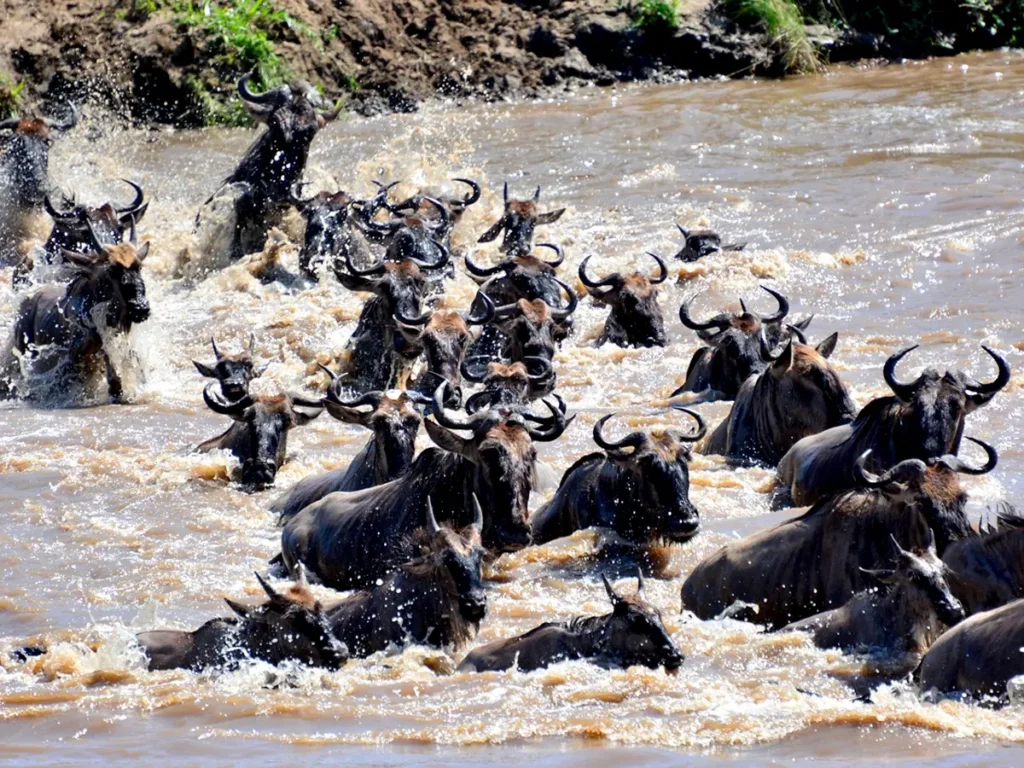
The wildebeest, or gnu, is a member of the antelope family and the protagonist of the world’s greatest terrestrial odyssey. The Serengeti-Mara herds undertake a vast annual migratory circuit in search of grass and water. This is why the wildebeest is not merely another grazing animal. It is the heartbeat of the Serengeti’s ecological drama. Watching a million-strong herd is a lesson in the collective rhythm of nature.
- The Unique Marvel: The Serengeti’s migratory herds are dominated by the western white-bearded form of wildebeest, weighing roughly 500 to 600 lbs. (3) Known as the “spare parts animal,” they possess a haunting, relentless endurance, with calving being one of its greatest survival strategies.
- Vital Statistics: Wildebeests can travel over 1,750 miles annually, following rainfall patterns. (4) Also, with around 80% of females calving within a narrow two-to-three-week window, this abundance of newborn life is what fuels some of the Serengeti’s most intense predator activity.
- One Nature Tip: At One Nature Nyaruswiga, guests can pair central Serengeti game drives with the Great Migration River Crossing excursion. At the One Nature Mara River, the northern location near Kogatende places guests close to the Mara River spectacle itself, providing a front-row seat to the crossing season.*
2. The Lion: The Ancient Echo of the African Savanna
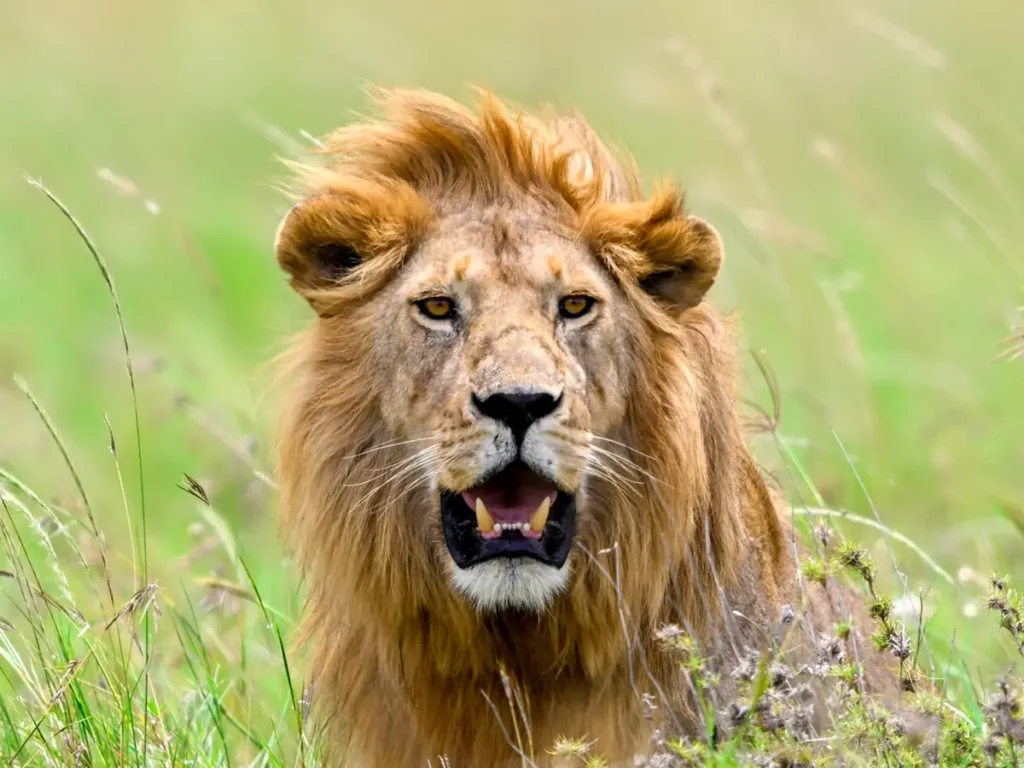
For many of our guests, the lion remains the most famous animal in Africa. The Serengeti hosts one of the largest concentrations of lions on earth. In safari terms, lions are the Serengeti’s great public drama. They are visible, social, territorial, and endlessly compelling. A lion sighting is often the moment when first-time safari guests feel the Serengeti become real.
- The Unique Marvel: The Serengeti lions are famous for their “tree-climbing” behavior, a rare adaptation to catch a breeze or escape insects. To hear a pride’s roar at night from your bespoke suite is to feel the heartbeat of Africa.
- Vital Statistics: A male African lion can weigh roughly 275 to 600 lbs. (5) and its roar may be heard up to 5 miles away. (6)
- One Nature Tip: Seronera is known as the Big Cat Capital of Africa, with dense populations of lions and excellent year-round wildlife density. For guests at One Nature Nyaruswiga, this is one of the strongest arguments for staying in Central Serengeti. The lion theatre starts close to camp. Our guides specialize in locating the massive prides of the Seronera Valley, often found roaming across the open savanna or lounging under acacia trees. *
3. The Rhinoceros: The Serengeti’s Rarest Living Fossils
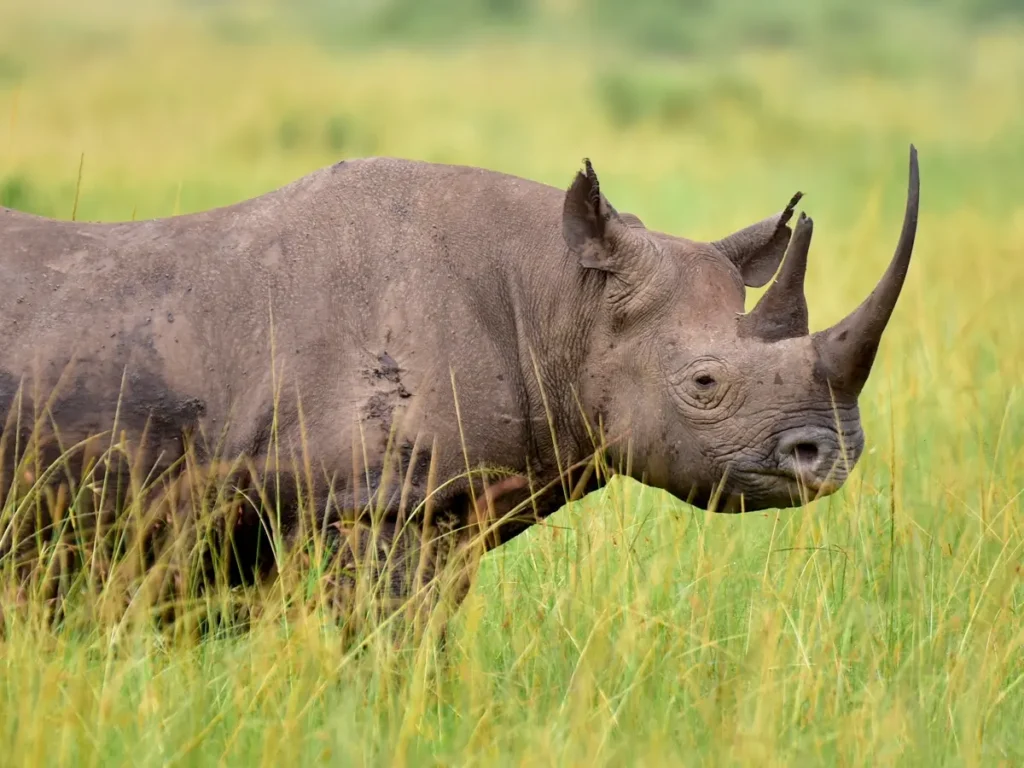
Rhinos are among the rare animals in Serengeti, and that rarity gives them an almost sacred force on safari. The black rhino remains critically endangered, and its sighting is never casual. In the One Nature universe, rhino viewing is tied to intention, patience, and access. Their presence speaks to protection, anti-poaching efforts, and the survival of one of Africa’s most imperiled megafauna.
- The Unique Marvel: The most elusive of the Big Five, the rhino is a symbol of both prehistoric power and fragile beauty. These “hook-lipped” browsers are incredibly solitary and possess a sense of hearing that compensates for their poor eyesight.
- Vital Statistics: Black Rhinos appear as ‘Critically Endangered’ on IUCN’s Red List. (7) Although addressed as black, they are grey-skinned with pointed lips. Their scientific name, Diceros bicornis, means “two-horned”.
- One Nature Tip: Our Moru Kopjes excursions offer rare access to seek black rhinos in their native habitat. Our seasoned rangers understand these shy, highly sensitive animals, and when conditions align, an exclusive rhino-tracking experience may be possible. By choosing this experience, our guests become a part of an extraordinary conservation effort. Additionally, we offer a visit to the Ngorongoro Crater, which is a Big Five arena. *
4.The African Elephant: The Big Five’s Gentle Giant
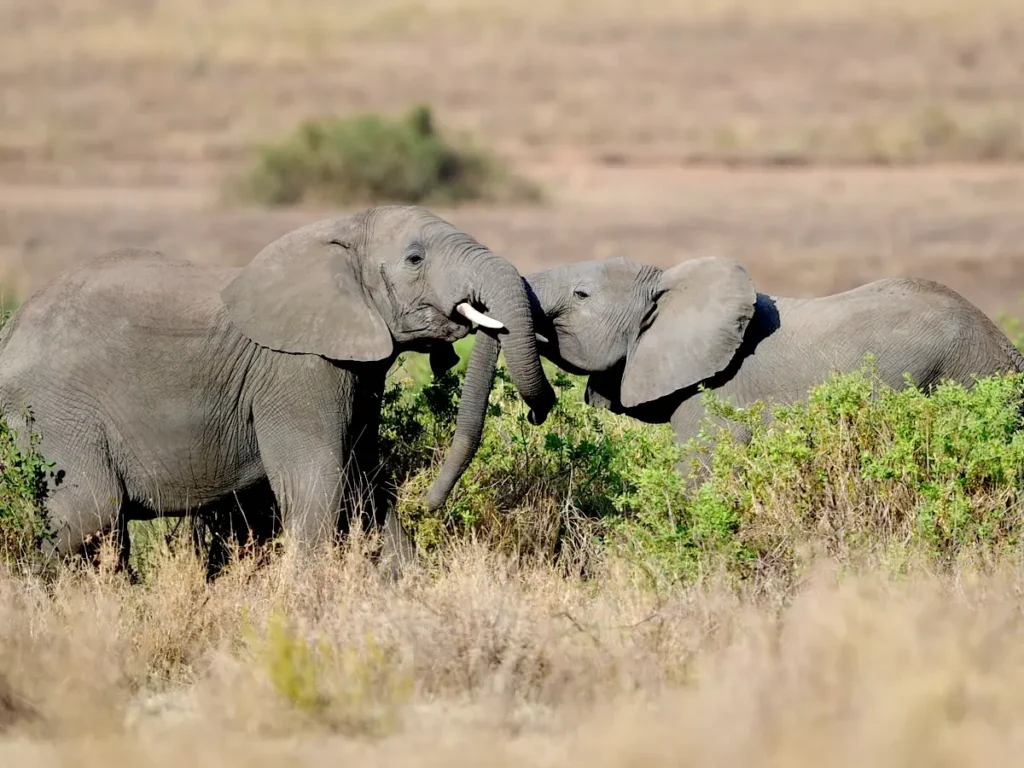
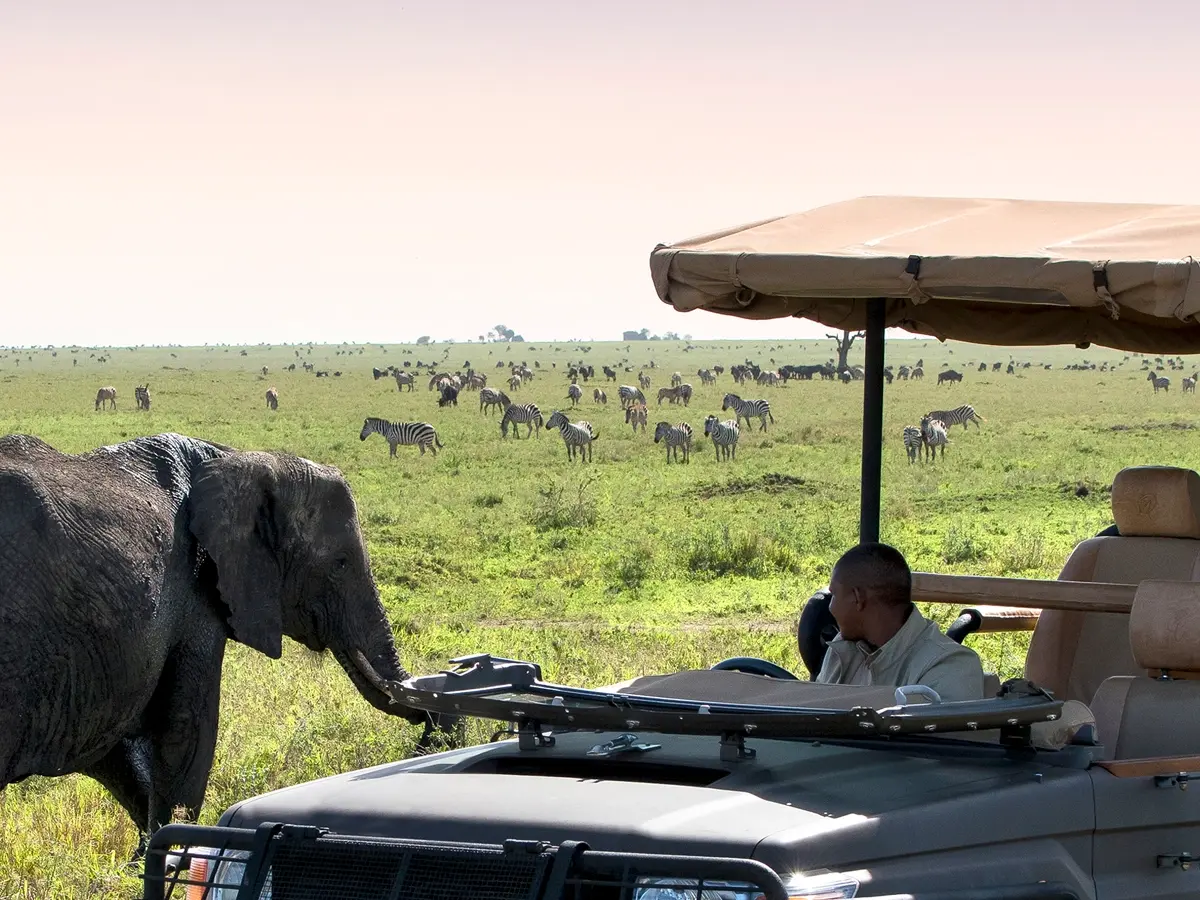
An endangered species, the African savanna elephants are among the most moving of all the best animals to see in Tanzania. They are not just large but are deeply social, highly intelligent, and structurally central to African ecosystems. Their family-led movements, tactile communication, and memory make them one of the most emotionally resonant animals to watch in the wild.
- The Unique Marvel: Their complex social structures and mourning rituals mirror the depth of human emotion. Few safari sights feel more commanding than a matriarch-led herd crossing an open plain.
- Vital Statistics: The African savanna elephant can reach about 6 tons and a shoulder height of around 11 feet. An adult requires up to 660 lbs. of food daily to sustain its massive frame. (8)
- One Nature Tip: Whether from your private vantage at One Nature Mara River or on a classic game drive from One Nature Nyaruswiga, elephant viewing here is not rushed. You might be lucky to experience a “silent encounter” as a herd wanders past your private deck, a moment of profound, quiet personal alchemy. *
5. The Leopard: The Aristocrat of the Serengeti’s Big Cat
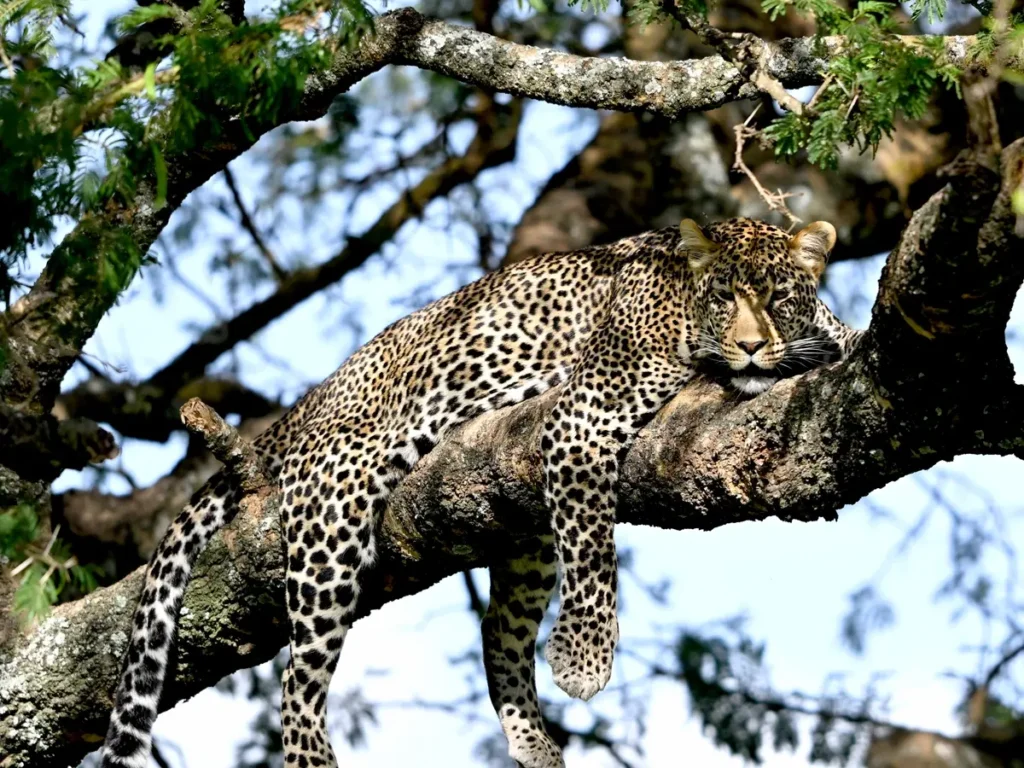
If lions are public power, leopards are private mastery. Leopard sightings feel intensely personal because they usually arrive as revelation: a tail over a branch, a spotted shoulder in riverine shade, a sudden, impossible elegance. Leopards are powerfully built carnivores with rosette coats. In practical safari terms, they are solitary, stealthy, and far less predictable than lions, which is precisely why seasoned travelers prize them.
- The Unique Marvel: They are the strongest of the big cats, capable of hauling prey twice their weight high into the acacia trees. East African leopards typically show more circular rosettes than their southern counterparts.
- Vital Statistics: Unlike other cats, leopards are comfortable in water and are adept swimmers. The Seronera riverbeds are world-renowned for leopard sightings.
- One Nature Tip: The Central Serengeti’s mix of riverine cover and prey density is a classic leopard equation. Our high-spec safari vehicles ensure you see them in perfect clarity if nature brings them to your sight. *
6. The Grant’s Zebra: The Striped Geometry of the Great Migration
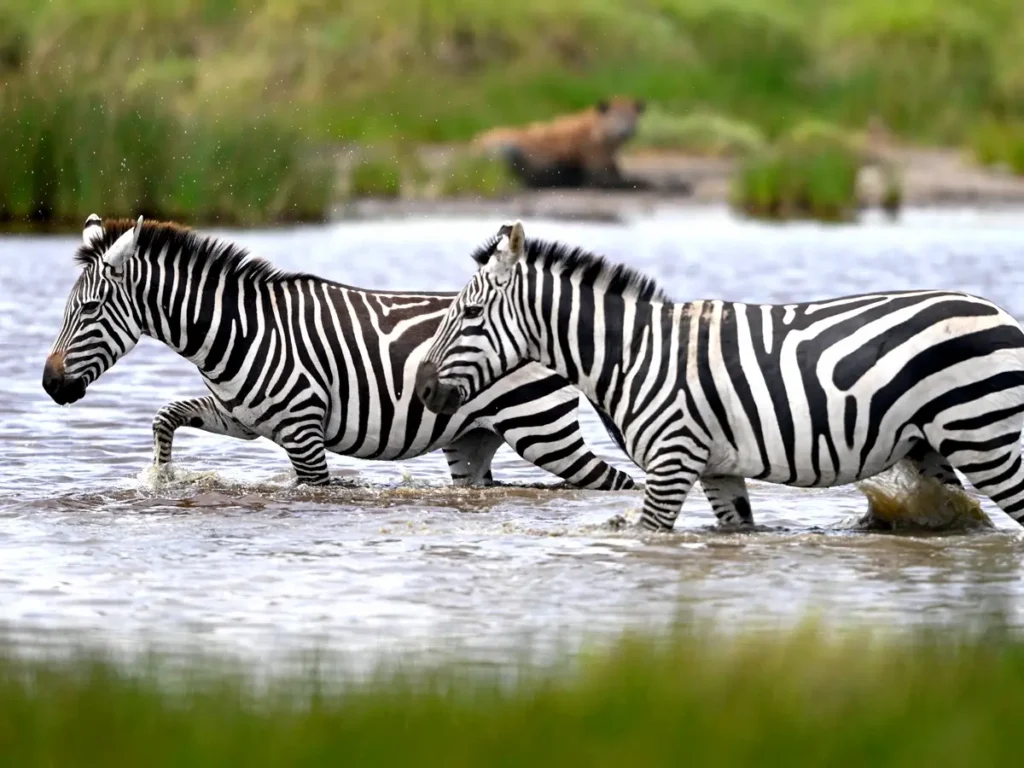
When guests ask what animals live in the Serengeti or which are the best animals to see in the Serengeti, Grant’s zebras deserve to be named as protagonists, not supporting cast. They provide the visual rhythm of the migration, their black-and-white stripes creating a mesmerizing “motion dazzle” against the golden grass. In the Serengeti, their visual charisma is only half the story. They are essential migrators, grazing strategists, and companions to the wildebeest herds.
- The Unique Marvel: No two zebras have the same stripe pattern. They are as unique as a human fingerprint. Their role in migration is strategic. Zebras often graze coarser grasses first, leaving shorter, more nutritious growth for wildebeest behind them. That ecological choreography is one reason migration scenes feel so layered.
- Vital Statistics: More than 75% of the world’s plains zebras are Grant’s zebras, which can migrate up to 1802 miles for food and water. (9) This Serengeti-Mara form of the plains zebra is strongly associated with East Africa’s great migratory theatre.
- One Nature Tip: At the Mara River, zebras become river-crossing protagonists, often massed beside wildebeest at the water’s edge. On central Serengeti drives, they are a key photographic subject against the park’s open gold plains. Observe them in the early morning light when the contrast of their stripes against the Serengeti green is a photographer’s dream. *
7. The Cape Buffalo: The Dark Force of the Big Five
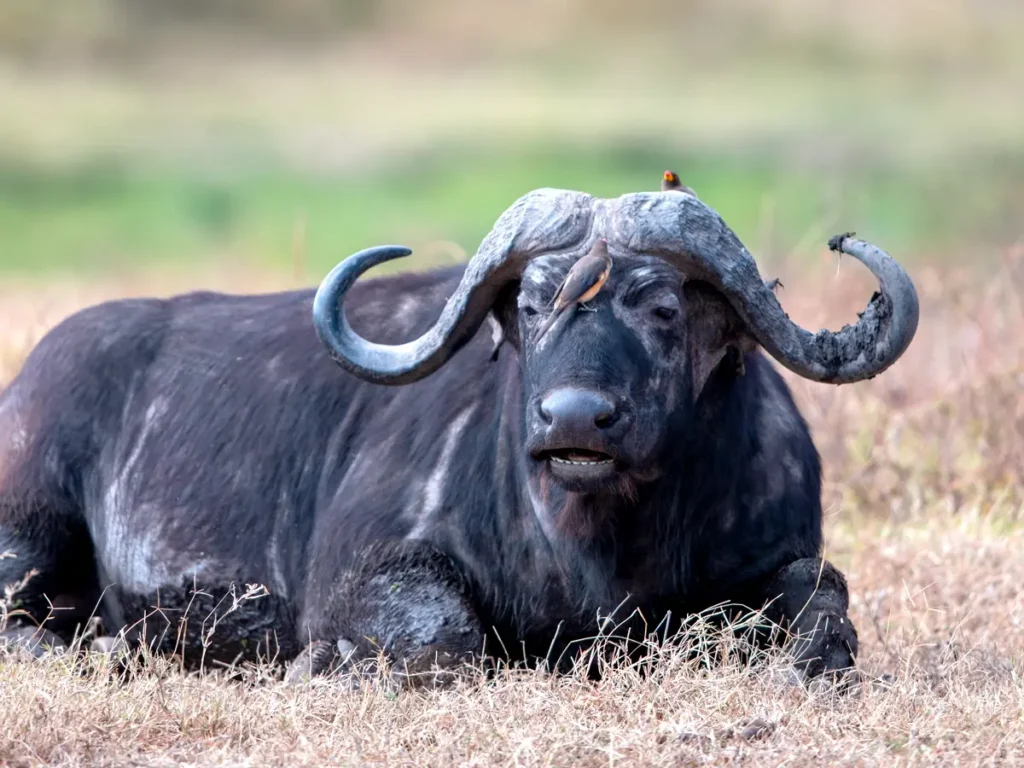
Buffalo rarely receive the glamor lavished on lions or leopards, yet they remain one of the most formidable Serengeti national park animals. Thick-skinned, horned, communal, and entirely capable of turning the balance of danger, they are the heavy infantry of the plains. On an African safari, a buffalo herd can appear placid until one understands how much tension sits inside it.
- The Unique Marvel: The buffalo is the most respected member of the Big Five, known for its formidable “boss” (horns) and unwavering courage. They are known as “The Black Death” due to their protective nature; they never forget a threat and will defend the herd at all costs.
- Vital Statistics: They are exceptionally water-dependent and are never found more than half a day’s walk from a source. African buffalo can weigh about 661 to 1841 lbs., stand around 1 to 2 meters tall, and move between forest and open plains. (10)
- One Nature Tip: Keep an eye on open grasslands and water-rich areas, where Cape buffalo are often found moving in formidable herds. At Ngorongoro Crater, a Big Five-rich extension from Nyaruswiga, buffalo add heft to an already exceptional wildlife mix. *
8. The Cheetah: The Spirit of Speed
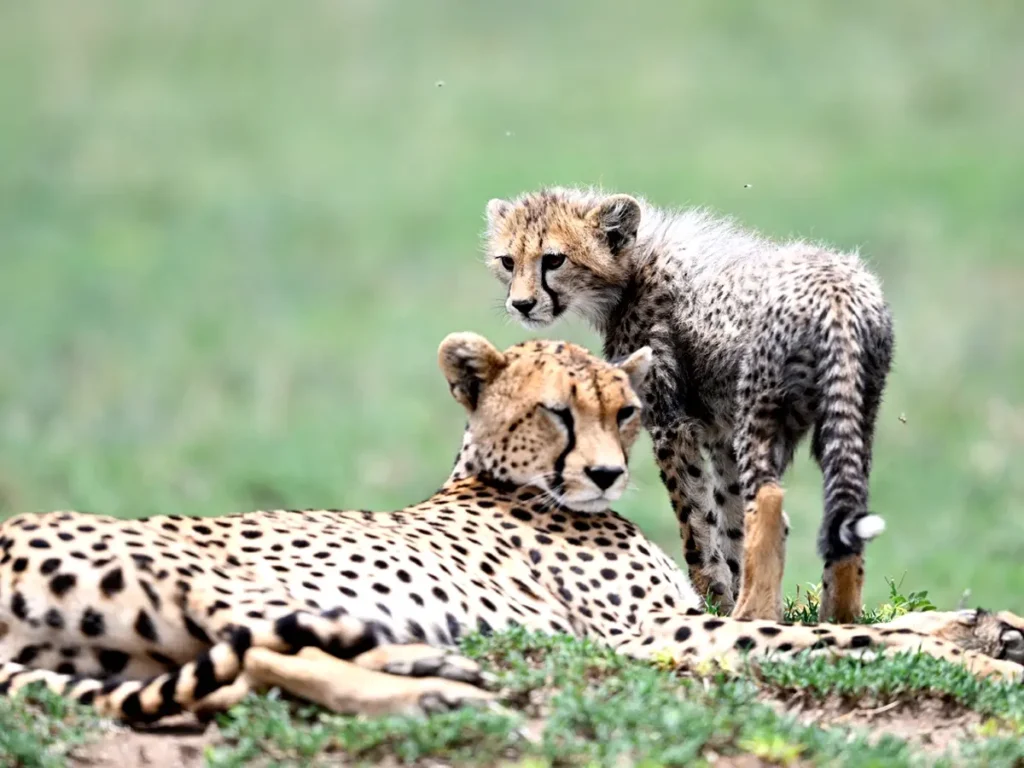
Cheetahs are among the best animals to see in the wild because no photograph quite prepares you for their economy of movement. The Serengeti’s open plains are the perfect stadium for the world’s fastest land animal.
- The Unique Marvel: Built like a greyhound, the cheetah is the only cat that cannot retract its claws, giving it permanent “cleats” for traction. Also, individual spot patterns allow researchers to monitor cheetah life histories over generations. This is one of the reasons a cheetah sighting here feels so intellectually rich as well as thrilling.
- Vital Statistics: With around 225 cheetahs in the ecosystem, the Serengeti is one of Africa’s finest cheetah destinations for serious wildlife travelers. They can accelerate from 0 to 60 mph in just three seconds. (11)
- One Nature Tip: For guests wondering where to see cheetah in Serengeti or how to spot a cheetah in Serengeti, open plains, termite mounds, and expert visual scanning remain the classic formula. Our expert guides track the “coalitions” of males who hunt in the wide-open spaces of the southern plains during the calving season. *
9. The Masai Giraffe: The Watchtower of the Serengeti
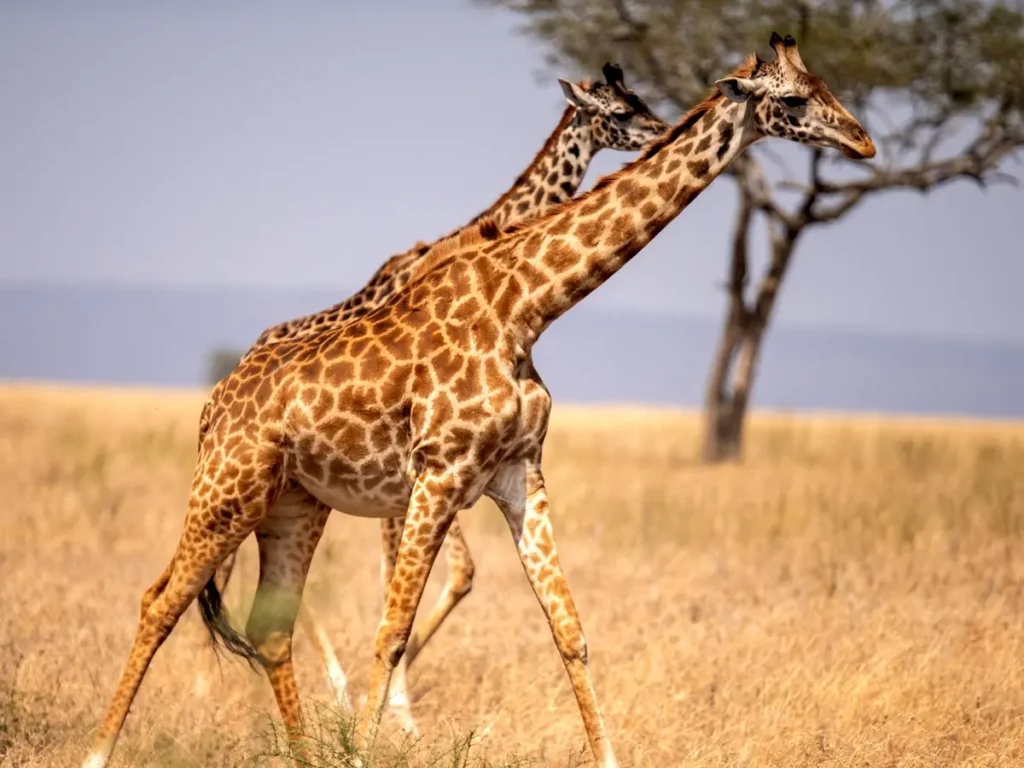
Masai Giraffes soften the Serengeti’s violence without ever diminishing its grandeur. With a grace that defies their height, they move through the acacia woodlands like silent, spotted sentinels. The species that feels most graceful on safari is also one that deserves deeper conservation efforts in the Serengeti.
- The Unique Marvel: Necks of giraffes have only seven vertebrae, the same as a human, just significantly elongated. That vertical elegance gives them a special place in the Serengeti composition. They are often the animal that makes a landscape feel unmistakably African, especially at first light and last light.
- Vital Statistics: A giraffe’s heart weighs approximately 25lbs. to pump blood up its long neck to the brain. (12) With only around 4,000 giraffes in the ecosystem, the subspecies is classified as endangered. (2)
- One Nature Tip: A sunset ‘giraffe’ moment on the plains is where their silhouettes against a blood-orange sky define the Serengeti aesthetic. On some days, they might not be there while, on other days, they can be everywhere, be it on game drives or around the wider camp landscapes.
10. The Nile Crocodile & Hippo: The River Titans
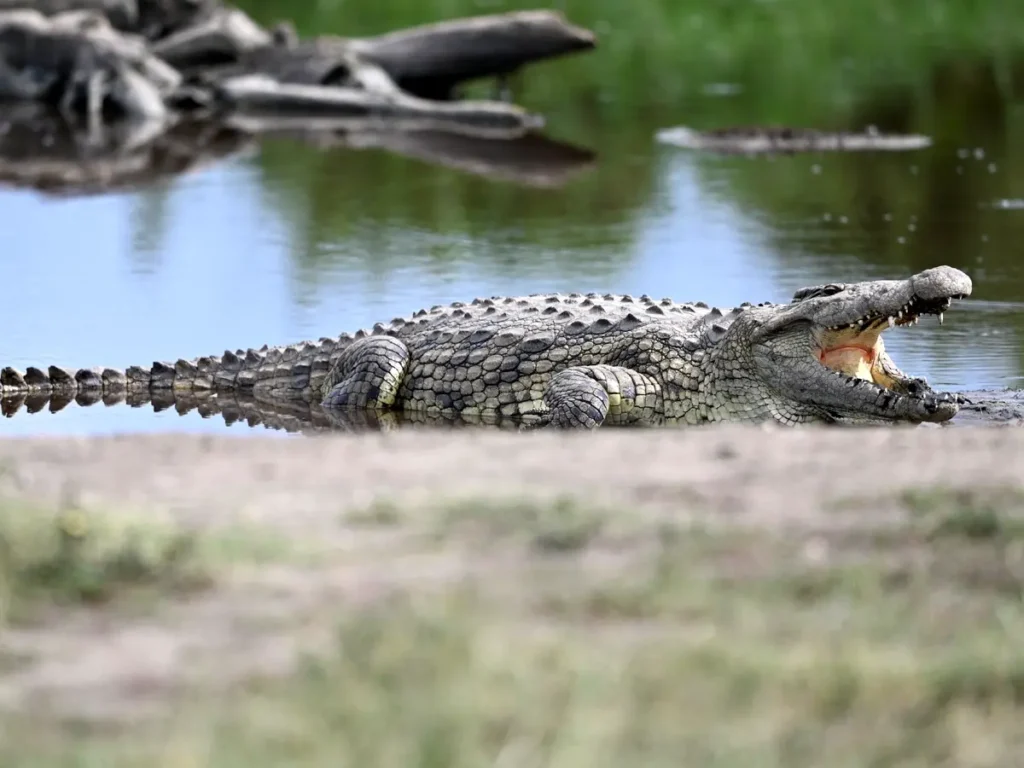
If the open plains belong to the cats, the water belongs to hippos and crocodiles. In the rivers of the Serengeti, these two giants represent the ancient, dangerous beauty of the water’s edge. The hippo’s apparent stillness is deceptive. During migration season, crocodiles transform river crossings into one of Africa’s most primal wildlife spectacles. This is the part of a luxury African safari where the Serengeti stops feeling picturesque and starts feeling elemental.
- The Unique Marvel: Hippos are the “architects of the riverbeds,” while crocodiles can wait for months in a state of suspended animation for a single meal. For travelers seeking the fiercest predator-prey theatre in East Africa, this is among the most dramatic wildlife experiences available anywhere on the continent.
- Vital Statistics: While the Serengeti profile lists about 500 hippopotamuses in the ecosystem, the Nile crocodile, by contrast, remains Least Concern. A crocodile’s bite force is the strongest ever recorded in the animal kingdom. (2)
- One Nature Tip: Mara being a crocodile-infested crossing country, our expert guides lead guests to prime viewing locations like the incredible “Hippo Pools” where hundreds of these giants congregate in vocal, splashing displays. *
Frequently Asked Questions About Serengeti Animals
What animals can you see in the Serengeti?
A serious Serengeti safari can include all of the Big Five, vast wildebeest and zebra herds, cheetahs, hyenas, giraffes, hippos, crocodiles, antelope, primates, and extraordinary birdlife. UNESCO’s official World Heritage profile describes the park as supporting over 70 large mammal species and more than 500 bird species, which is why the Serengeti remains one of the best places to see animals in Africa. (2)
What is the best time to see animals in the Serengeti?
The answer depends on the wildlife moment you want most. Central Serengeti, including the Seronera region, offers rewarding year-round game viewing and especially strong big-cat sightings. December to March is prized for calving season and predator action, while May to July is associated with Grumeti movement, and July to August, sometimes into early autumn, is prime for Mara River crossing drama.
Is a wildebeest an antelope?
Yes, the wildebeest, or gnu, is a member of the antelope family. In the Serengeti, that antelope becomes something much larger in ecological significance, namely the migratory engine that shapes predator behavior, river drama, and the seasonal rhythm of the plains.
Are there rhinos in the Serengeti, and are rhinos extinct?
Rhinos are absolutely still part of the Serengeti story, though sightings are rare and deeply prized. Black rhinos are not extinct, but they remain critically endangered. As per UNESCO, the latest black rhino figures list about 200 in the Serengeti National Park. (2) One Nature adds exceptional value through its Moru Kopjes experience, Ngorongoro Crater extension, and potential rhino-tracking opportunities when conditions allow.
Are there giraffes, cheetahs, hippos, and crocodiles in the Serengeti?
UNESCO’s Serengeti profile lists about 4,000 giraffes, 225 cheetahs, and 500 hippopotamuses in the ecosystem, while the Mara River crossing experience explicitly highlights Nile crocodiles as central to migration season drama. (2) These are not fringe sightings but are part of what makes the animals in the Serengeti so diverse and so unforgettable.
Why One Nature is One of the Finest Ways to Experience Serengeti Wildlife
The difference between a good African safari and a transformative one usually comes down to location, guiding, and pace. One Nature does not promise wildlife at cue, as every sighting is a matter of nature’s plan. Instead, it offers something far more meaningful. Time in the right places, guided by those who know them the best. One Nature Nyaruswiga places guests in the Central Serengeti, close to Seronera’s year-round wildlife density and big-cat action, while One Nature Mara River provides guests with elegant access to the northern Serengeti migration country and the legendary Mara River crossings. Add expertly guided game drives, bespoke vehicles, rhino-focused excursions such as Moru Kopjes, the Ngorongoro Crater Visit, and the rare privilege of seeing these animals in uncompromising comfort, and the experience becomes something far more enduring than a holiday in Africa.
At One Nature, luxury does not distract from the wild but refines the way you meet it. You return not only with photographs of the best animals to see in Africa, but with a more intimate understanding of their patterns and survival secrets, their landscapes, and our wildlife conservation efforts in Tanzania. That is the finest kind of safari holidays for families as well as couples on honeymoon safari. Not simply seen, but deeply felt!
References:
-
- 1. Fuqua, A. (Director). (2026). Michael [Film]. Lionsgate; Universal Pictures; GK Films; Optimum Productions.
- 2. UNESCO World Heritage Convention (n.d.). Serengeti National Park. [The List]. https://whc.unesco.org/en/list/156.
- 3. Encyclopaedia Britannica (n.d.). Britannica Kids: Wildebeest. https://kids.britannica.com/kids/article/wildebeest/602322.
- 4. National Geographic Society (30.11.2021). Serengeti in Motion: How A Dynamic Landscape Drives One of the Last Remaining Large-Mammal Migrations on Earth. https://www.nationalgeographic.com/magazine/graphics/tracking-the-great-serengeti-wildebeest-migration-feature.
- 5. WWF-UK (n.d.). Top 10 Facts about Lions. https://www.wwf.org.uk/learn/fascinating-facts/lions
- 6. BBC (n.d.) Radio 4: Nine Roar – Some Facts about Lions. https://www.bbc.co.uk/programmes/articles/1WXqfwCNlzqwLTQfMTDSgY5/nine-roar-some-facts-about-lions#:~:text=1.,far%20away%20as%20five%20miles.
- 7. Emslie, R. 2020. Diceros bicornis. The IUCN Red List of Threatened Species 2020: e.T6557A152728945. https://dx.doi.org/10.2305/IUCN.UK.2020-1.RLTS.T6557A152728945.en.
- 8. Stephenson, P.J. (2007). WWF Species Action Plan: African Elephant, 2007-2011. WWF, Gland, Switzerland. https://wwfeu.awsassets.panda.org/downloads/wwf_sap_african_elephants_final_june_2007v1_1.pdf
- 9. African Wildlife Foundation (n.d.). Zebra. https://www.awf.org/wildlife-conservation/zebra.
- 10. African Wildlife Foundation (n.d.). African Buffalo. https://www.awf.org/wildlife-conservation/african-buffalo.
- 11. Cheetah Conservation Fund (n.d.). About Cheetahs. https://cheetah.org/learn/about-cheetahs/.
- 12. PBS. (2020, July 15). Giraffe Fact Sheet. Nature. https://www.pbs.org/wnet/nature/blog/giraffe-fact-sheet/#:~:text=A%20giraffe’s%20heart%20is%202,hold%2012%20gallons%20of%20air.